
Home
A comprehensive resource for safe and responsible laser use
US: Marines to buy 1,653 eye-safe laser dazzlers
- An infrared (1535nm) laser rangefinder determines the distance to a person or object. The closer the distance, the lower the laser power output.
- Near-field detection shuts off laser emission if a person or object is too close to the laser output aperture.
- A 3-axis gyroscope detects motion. If the Glare Recoil is suddenly moved, the laser shuts off until stability is resumed and an accurate determination of the distance to a person or object can be re-established: “This prevents hazardous irradiance in situations where Glare Recoil is moving faster than the laser rangefinder can detect objects and dose power output. This results in the prevention of eye hazard danger caused by rapid movement of the device (example: flagging) or improper situational awareness of the operator.”
With these technologies, the laser detects objects or people in the proximity of the beam and then self-adjusts the power output to maintain eye safety. The Nominal Ocular Hazard Distance is said to be 0 meters; the range is 10 feet to 10 miles.
Suggested uses include urban patrolling, cordon and search, crowd control, clearing facilities and security checkpoints.
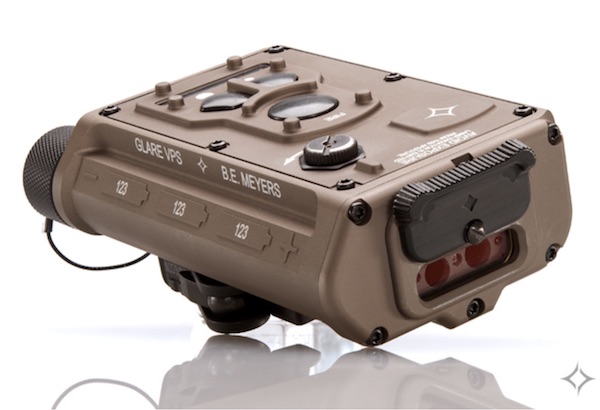
The Glare Recoil is about the size of a Walkman tape player at 5.5” x 3” x 2”. It can mount on a rifle or be handheld.
Meyers also sells a Class 1M “Glare Helios” which has an FDA variance allowing sales to U.S. local, state and federal law enforcement, and U.S. flagged vessels.
From Marine Corps Times, Soldier Systems, and B.E. Meyers. A video produced by the company goes into detail about the specifications and how the person/object detection works.
Ukraine: Developing countermeasures after 4 cases of laser eye injury
“We already had several such cases (a laser injury of the eye retina) in the State Border Guard Service and in the National Guard. We are now developing countermeasures. We do not fully understand what they use, but we are already working on the instructions what it could be. We will install the appropriate filters, devices, use appropriate glasses,” Avakov said.
He reported on four cases of the laser injury of border guards and national guardsmen.
“The use of such weapons is a barbarous situation. We will discuss it at the international level,” Avakov emphasized.
From Kyiv Post
China: Military is equipped with blinding laser weapons
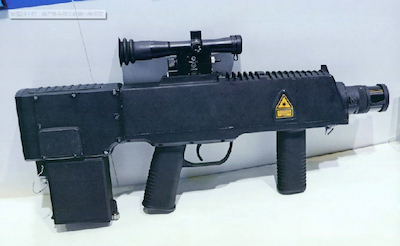
BBQ-905 Laser Dazzler Weapon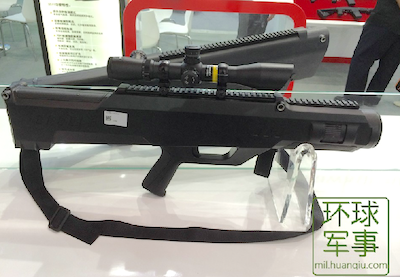
PY132A Blinding Laser Weapon
China’s use of the weapons appears to violate the 1998 Protocol on Blinding Laser Weapons, which China has agreed to follow. A Washington Free Beacon article quoted an expert on Chinese weapons as saying “There is a strong possibility these new dazzlers are being marketed for foreign sale.”
From China Military Online via the Washington Free Beacon. Additional photos showing the weapons and how they would be used are at Huanqui.com.
US: $208 million contract to protect Army helicopters from laser threats
The Army/Navy Piloted Aircraft/Visual and Visible Light/Receiving, Passive Detecting (AN/AVR-2B) Laser Detecting Sets (LDS) uses four sensor units placed on the aircraft. It is smaller, lighter and uses less power than a previous generation developed for the cancelled Comanche helicopter program.
News reports did not state how much it costs to equip each helicopter with an AN/AVR-2B system.
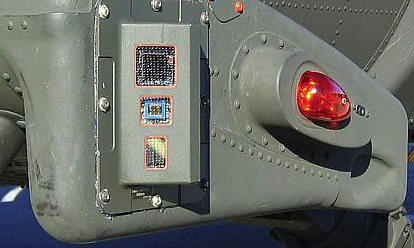
One of the four sensor packages to detect laser threats on U.S. military helicopters
From Avionics Intelligence August 31 2013 and September 3 2013
US: "The Straight Dope" answers the question "Should I be afraid of laser pointers?"
The answer first noted that laser weapons are large. An anti-missile laser required a Boeing 747, the Navy set fire to a boat with a destroyer-mounted laser, and a dazzler-type laser called the PHaSR is as portable “as a bag of cement.”
Then, Straight Dope purchased a 1 watt blue handheld laser (the same or similar to the Wicked Lasers Spyder III Arctic). They aimed it at room temperature pork chops and bacon. From one foot away, it took 27 seconds of continuous exposure before smoke appeared. Even with matches, it took 11 seconds to light a match from one foot away, and 15 seconds from 32 feet away.
The January 6 2012 column concluded that handheld laser ray guns are not practical: “…the likelihood that this laser would actually change somebody’s mind (other than via intimidation alone) is virtually nil…. no bad guy is going to sit still while you fry him.”
Story and photos are at the Straight Dope website. The column was also printed in the Washington City Paper.
UPDATE: In comments at the Washington City Paper, “dave b” noted that exposure to skin isn’t necessarily the important factor: “The key is to get the laser into someone’s eye.”
.
US: Military aircrews can use finger-mounted laser pointers for target identification
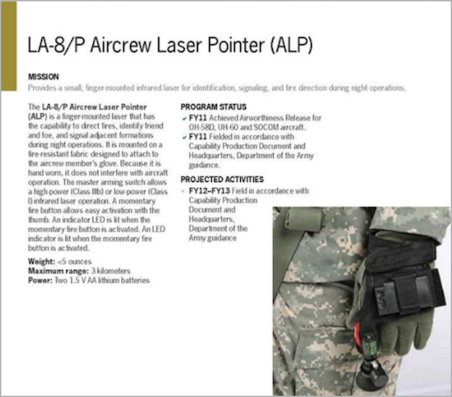
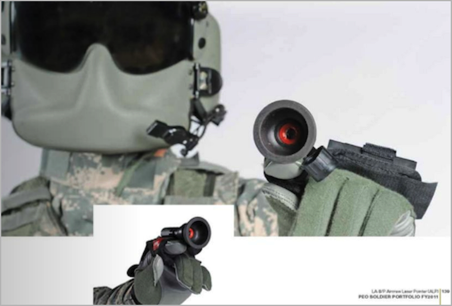
For the military laser enthusiast, the catalog contains a number of other laser devices such as the AN/PEQ-14 Integrated Laser White Light Pointer (actually a white flashlight plus a visible and an invisible laser):
From the Program Executive Officer Soldier Portfolio FY2012 catalog. The LA-8/P is on printed pages 138-139, electronic pages 146-147. Originally found via GovWin.
Commentary from LaserPointerSafety.com: Although the LA-8/P Aircrew Laser Pointer does not emit a visible beam, it would be easy to make a visible version so that aircrews could “fire back” at persons on the ground aiming laser pointers at them. Whether this is a wise idea is another matter.
.
US: Report says Iran blinded CIA satellite with laser
This was the only laser-related information in a December 15 2011 article that was otherwise about Iran tricking a U.S. drone into landing in Iran by jamming its GPS position signals.
From the Christian Science Monitor; the laser paragraph was on page 2 of the online story. See also an October 2011 Washington Post story analyzing a politician’s claim that China blinded U.S. satellites in 2006.
.
UK: Police dazzler laser being tested to flashblind rioters
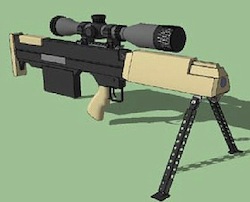
Concept of the rifle, from the Daily Mail
The developer is Photonic Security Systems, which also markets the rifle as a pirate deterrent. The Telegraph says that similar devices have been used in Afghanistan by NATO-led International Security Assistance Force troops.
PSS managing director Paul Kerr told the International Business Times "The very purpose of this technology is to be non-damaging … If someone is prepared to just stand there and stare down the barrel at this, which would be incredibly uncomfortable, then they are definitely a threat.” He said that he has often been exposed to the laser: "The quality and safety of the device is paramount and I know that first hand because I have been the guinea pig many times. I know what it is like and I know how effective it can be."
Author and activist Cory Doctorow points out that “the UK is a signatory on the Protocol on Blinding Laser Weapons … this weapon wouldn’t run afoul of international law if it (merely) reduced your vision to the point where you were impaired but not legally blind, permanently.” Doctorow also says “Twitter wags are already predicting a resurgence of mirrorshades [reflective sunglasses] among protesters.”
From the Telegraph, the Daily Mail, the International Business Times and BoingBoing. See related story on BAE Systems anti-pirate dazzler.
.
US: Politician says China blinded U.S. satellites with lasers
US: Military helicopters may use lasers to fight ground-based attacks
Black Hawk and Chinook helicopters have been testing a acoustic detection system called “Helicopter Alert and Threat Termination”, or HALTT. This uses microphones to detect the sound of a bullet or RPG. Delays in the sound reaching the microphones enables them to determine the sound’s location. A similar truck-mounted system is already in use. It can automatically swivel and fire a gun in the direction of the sound.
For helicopters, HALTT can be combined with guns and/or lasers. Infrared lasers help confuse missile guidance systems, while visible lasers would dazzle and flashblind anyone aiming at the helicopter. An engineer said the principle is to “make it impossible for a human to observe your aircraft … by creating a distracting light source. That has been done in the past and is a proven technology…”. The HALTT/laser countermeasure system could be in use by 2017.
The military already uses laser dazzlers at checkpoints, to warn approaching vehicles and to cause glare on anyone taking aim at soldiers.
From Wired and Defense Tech. A video of how the IR system would work against a missile is at YouTube.
US: Pentagon delayed using laser dazzers in Iraq
During the U.S. phase of the Iraq war, Marine Corps leaders requested the handheld devices as a way to warn and stop drivers who were overrunning military checkpoints. Wired’s David Axe estimates that “as many as 50” Iraqi civilians were killed by gunfire -- instead of being forced off the road by dazzlers -- during the nine month delay.
There is some dispute over the safety of laser dazzlers. According to the Inspector General’s report,
Laser dazzlers provide a nonlethal capability by emitting an intense light capable of temporarily obscuring the vision of approaching individuals; however, using lasers poses a risk of serious eye injury and permanent blindness. This mode of employing a laser, shining a laser directly into the face or eyes, increases the inherent dangers of using the laser. Using nonlethal laser dazzlers would give Marine operating forces an additional capability to increase stand-off distances, safeguard civilians who venture too close to Marine positions, and help prevent unwarranted escalation of force incidences; however, DoD [Department of Defense] policy prohibits the use of lasers designed to cause permanent blindness. Operating procedures and laser safety measures are essential to ensure the safe and proper use of the lasers.
The Inspector General’s report contains additional details about the range, capabilities, safety concerns and policy issues related to military use of laser dazzlers. For example, the 1995 Protocol on Blinding Laser Weapons states that the signatories (which include the U.S.) “shall take all feasible precautions to avoid the incidence of permanent blindness to unenhanced vision.”
From Wired.com.
UK: Laser "dazzler" from BAE Systems for use against pirates and other threats
Roy Clarke, BAE Systems capability technology lead for laser photonic systems, said: “The effect is similar to when a fighter pilot attacks from the direction of the sun. The glare from the laser is intense enough to make it impossible to aim weapons like AK47s or RPGs, but doesn’t have a permanent effect.”
From the BAE Systems press release.